Showing posts with label Chemistry. Show all posts

Monday, September 13, 2010

PAHs and the development of life


If you've ever been curious about the origin of life and how it arose from nonliving molecules, for the past few years there's a mindblowing new scenario on how that could have happened centered around Polycyclic Aromatic Hydrocarbons as an intermediate "starter" stage that leads to life. Not because of PAH's complexity, but because of how durable they are, how simple they are.

PAHs, in short, are polycyclic because they are typically carbon atoms that form into extremely durable ring structures, connected to each other. As anyone that's ever played with a molecular model kit knows, carbon atoms connect at angles that result in a cyclic shape. Because the carbon atoms double-bond to each other over and over, they have a real toughness by sharing bonds, a property in chemistry known as "aromatic."

PAHs are found over and over on earth, and in fact are even one polycyclic aromatic molecule (though not a hydrocarbon), C60, was the first soccer-ball shaped buckminsterfullerine ever discovered in nature, a sexy kind of molecule that gets a lot of attention because of unique properties. Flatten a buckyball out into a sheet of graphene (well, more or less), curl it up and you get carbon nanotubes, a molecule with the primary property of creating tons and tons of work for sensationalist science writers prone to jumping the gun.


Amusingly enough, one PAH is Naphthaline, C10H8, which is the primary ingredient of mothballs.

Not only is C60 as well as PAHs found in interstellar space where the primary components of life are believed to be found, the strong bonded structure means it can tolerate resistance and survive untouched in space, surrounded by UV light that would break up and destroy more fragile components of organic chemistry, like amino acids. Likewise, they're far simpler, just basic ring-shaped hydrocarbons that because the cyclic shape repeats over and over, it remains intact even if blown apart. It is believed they could have formed primitive membranes that protected life, helped in metabolism, and can even hold genetic information...the only material known in the interstellar medium that meets all three criteria for life.

Because of their stability and resistance to temperature and radiation, if PAHs played a role in the development of life on earth, it would change the conditions that are required for life to form, which may mean that life can develop in environments more deadly and dangerous than previously thought.


Tuesday, July 27, 2010

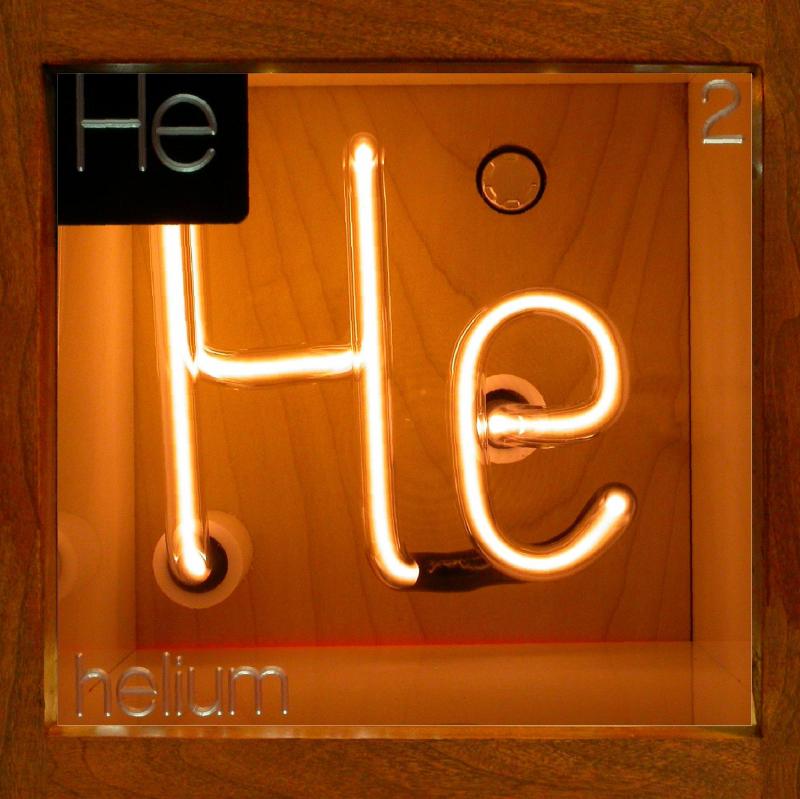
Hooray for Helium!


The single most extraordinary thing about helium is this: it was discovered on the sun before it was ever discovered on the earth, way back in 1868, when the lines on the emission spectrometer turned on it gave back a result that, at first, solar-observing scientists thought was sodium until they realized what it was they had. In fact, that's where the name for the element comes from: helium, like Helios, Greek god of the Sun.

(Incidentally, whatever happened to Helios, anyway? Come Roman times, Apollo was god of the Sun. The best answer ever came in the Percy Jackson and the Olympians young adult books: poor Helios was "downsized" by the efficient Romans and his job palmed off to an already overworked god.)

As point in fact, there is almost no helium on earth; it is light enough that it evaporated during the planet's formation, and any new helium tends to float off into space. The occasions where helium exists on earth, it's produced by the breakdown of radioactive elements like uranium and thorium and trapped in the earth.

This late discovery - Helium was only discovered on earth in 1895 - is all the more incredible because Helium is the second most common element in the universe. In fact, there is more helium than there is every heavier element put together.


More Helium facts:

Helium is one of the few elements to have no "solid" state, remaining a liquid even up to absolute zero.

Helium (and an isotope of Helium) are one of the few elements to be created by the Big Bang, along with hydrogen, lithium and beryllium. Most of the helium in the universe was created by the big bang, though many more from stellar processes.

The primary use of helium is, believe it or not, in cryogenics and supercold, especially the temperatures needed for powerful magnets. Helium is the second-most chemically inert, nonreactive element and in the column with the Noble Gases, so it makes a great purge gas as it doesn't bond with anything. In fact, there are no known compounds that exist that contain helium. The stability of helium is why it is often created by nuclear processes.

80% of the world's helium comes from refining natural gas in the United States. It was us Americans denying helium as a lifting gas to the Nazis that made them use the more dangerous and flammable gas hydrogen...and led to the Hindenburg disaster.

Why does inhaling helium make your voice higher? Well, here's an involved answer: sound is made by vibrating AIR, not by a vibrating object. Sound, like everything else is a wave, and the faster the number of peaks go by in the wave, the higher the frequency (the more frequent - get it?) and the higher the timbre of a noise. Frequency = Speed/Wavelength, or F = S/W. So, the faster something moves, the greater the number of waves and the "higher" a sound is. Since helium is less dense than air, sound goes through more quickly, and therefore the frequency is higher. Don't worry, helium is inert: the only danger comes from possible oxygen deprivation. There are some gases heavier than air that make vibrations travel more slowly, of course, like sulfur hexaflouride and krypton, but unlike helium these may be dangerous to try. They stay in your lungs as they "sink" in air.

Tuesday, July 6, 2010

E.E. Smith, you fail science forever!


Science Fiction readers wish they were scientists the same way Tom Clancy readers wish they were Army Rangers and Navy SEALs.

In the early days of science fiction, to have someone that's an honest-to-goodness PhD in science the way most of those early science-obsessed fanboys (and some girls) wished they were, must have been a real treat, something that gave authenticity to the stories. Science Fiction and magazines were seen as a tawdry waste of time, and real-life PhDs in science had better things to do than to give material to Hugo Gernsback and other magazine editors.

Nowadays, a lot of science fiction writers are PhDs: Isaac Asimov, famously, had a PhD in both Physics and Biochemistry (back when it was still called that), Larry Niven has a Masters in Mathematics, and Timothy Zahn was a Physics PhD candidate. Back in the 1930s, though, you took what you could get, and E.E. Smith and his editors were extremely proud of his PhD. Just look at those covers: E.E. Smith...PHD. It's like the PhD is Gladys Knight, and the rest of him are the Pips.

Too bad Smith's degree was in Chemistry, specializing in donut mixes.

Smith had a prose style that could best be described as YELLING, and his technobabble is some of the most astounding I've ever seen (is that why they call it 'Astounding Stories?'), and I watched Star Trek: Voyager. I don't like nitpicking science errors in science fiction, because that's just disruptive to suspension of disbelief, and I'm a good sport when it comes to waiving it in the writer's benefit...but I judge an honest-to-God PhD like donut-boy here by a different standard.

There are some truly headscratching things even in the field of chemistry. Smith's tactic is to browbeat the reader with fifty buck words until they are forced to believe his scientific concepts to make the barrage stop. It's called "suspension of disbelief by intimidation." Or "may the power of bullshit repel thee!"

Take for instance, a real howler in his book Triplanetary. The villains are a weird rhino-squid race named the Nevians that have declared war on the human race. Their power source? Allotropic iron.

(An allotrope is a molecular structure with only one type of element. Depending on how the atoms are arranged, something can have different properties. For example, graphite and diamond are both allotropes that consist of nothing but carbon arranged differently.)


According to Smith, this allotrope of iron is radioactive...so much so that 10% of its mass is switched to energy over time. As it does so, the binding content of the atom is released. This sort-of makes sense, as Iron has more binding in its atoms than any other you care to name. But otherwise...

1) Why would an "iron allotrope" make iron easier to crack apart at the atomic binding level? Iron atoms are iron atoms even if you arrange them differently. That's like saying walnuts are easier to break because you've got them spelling out "I Love You."

2) And this is the big one. Iron is the worst source of radioactive fuel in the entire universe. Literally! Seriously, Smith could have picked an element at random by spinning the periodic table and it would have made a better radioactive fuel source than iron. Iron absorbs nuclear energy, and iron buildup at the core of stars causes supernovas!

Iron is such a good absorber of nuclear reactions that it is actually the heaviest type of element that can be created by stellar processes alone. Only hydrogen existed in the early universe after the Big Bang, where the universe was so hot that fusion reactions could take place. After the Big Bang, five elements existed as a result: Hydrogen, Helium, Lithium and Beryllium, not to mention two isotopes of Helium. As a result of stellar conditions, heavier elements are created up to iron. Helium, in stars larger than our earth, create elements like oxygen, silicon and iron.

Iron has the lowest binding energy of anything, except maybe nickel, and from there elements increase in required energy further away from iron in both directions. Iron will absorb any additional energy placed on it! That is why iron is pretty much useless to any nuclear reaction you care to name - fusion or fission.

Iron is such a good collector of energy, in fact, that the only process that can create heavier elements than iron in the universe are supernovas, which use a high-energy process called beta decay to create the remaining elements (beta decay is a process where beta particles, a proton and neutron - are bounced around from atom to atom).

Dr. Smith, I had two semesters of physics and two semesters of chemistry at the undergraduate university level and I know this.

Smith gave another shocking science error in his novel Skylark of Space. Like the previous error, it was a physics and chemistry mistake that a PhD in Chemistry should know. In Skylark, the crew of an early spaceship land on a planet where salt catalyzes a metal to create super-armor, so the nation that has the table salt in the ship's galley could take over the planet. It reminds me of Matt Groening's "The Nation that Controls Magnesium Controls the Universe."
Now, I can sort-of accept that salt functions as a catalyst, depending on the reaction. Salt turns water into a better electrolyte (conductor of electricity), and oxidation (rust) is an electrochemical process, for example.

But salt being super-rare on an earthlike planet? Of all the materials in the universe to make super-rare on an earthlike world...! Okay, I can accept something like Scandium being super-rare, or Iridium, because those metals are very dense and aren't often found in the crust because they "sink." But salt is made of sodium and chlorine. Sodium and chlorine have two properties that make them super-common that a chemist should know:

1) They are among the ten most common elements in the crust of an earthlike planet, and are so because of their lightness;

2) They instantly combine with each other, covalently, because of their mutual charges. Alkali metals have an single electron, and halogens like chlorine have a free slot for an electron. Zap! They bind together.

There's no scenario where salt wouldn't be common, except for maybe a planet without an ocean or indeed, any water at all, that couldn't function as a solvent to break up earth compounds with both elements.

E.E. Smith may throw a ton of words of greater than five syllables around, and I guess that might be pretty good at suckering the rubes that don't know science. But when it comes to Smith's technobabble...take it with a grain of NaCl.

Monday, June 28, 2010

Quartz!


If you break down the composition of the earth's crust element by element, the two most common present in the rocks of the planet are 1) oxygen (locked up into solid molecules, of course) and 2) silicon.

So would it really surprise anyone that the single most common mineral on the crust of the earth is made of silicon and oxygen? Silicon Dioxide...better known as "quartz."

SiO2 is, in addition, the basis for many of the rest of the crystalline minerals, and it has a central role in the field of geochemistry.

Let's take the rest of the most common elements on the earth's crust: sodium, potassium, chlorine, aluminum, magnesium, iron, nickel.

When combined with oxygen, the metals form metallic oxides and non-metallic oxides. When the two types of oxides combine with SiO2, you get two major types of minerals in the earth's crust. When quartz comes together with the non-metallic oxides like potassium oxide, it creates the feldspars, the largest group of minerals on the earth's crust, defined by being light in color. On the other hand, when SiO2 combines with metallic oxide like ferric oxide or ferrous oxide (the difference between the two is an extra atom of oxygen in the valence) you get the ferromagnesian group of minerals.

The importance of quartz doesn't just stop there though. Water is a near-universal solvent and has a great way of breaking things down. The reason that the ocean is salty is because water dissolves the components of most continental rocks, including those made with sodium and chloride...which then proceed to combine in the water as sodium chloride, or sea salt. What happens to the quartz, though? The oxygen is dissolved in water, but the Silicon atom combines again with some others as a result of combining with water to create the various minerals we call the "clay" groups.

All things considered, quartz is pretty busy!

Quartz also has a really extraordinary property: because its crystalline structure is symmetrical it's piezoelectric, which means that it produces an electrical current when pressure is applied and the shape of the crystal is changed - or alternatively, the shape of the crystal changes when electricity is applied. This is because as it is perfectly symmetrical, it is impossible to separate its changes from pressure. Crystals can exist in one of 32 different forms - 20 of which are non-symmetrical, and quartz lucked out in that it can work this way.

Quartz crystals are generally useful when it's necessary to change energy from one form to another. Microphones turn sound to electrical energy. Though quartz was the first piezoelectric material discovered, it's barely used for that purpose these days: materials with large crystals are common like ceramic oxides (which are usually crystals of things like aluminum oxide).

Crystals are often used to power gadgets in science fiction like laser beams, but their greatest utility is in sound alteration: as quartz crystals work better at high frequencies, they're better at ultrasonics than normal sound waves.

Sunday, June 13, 2010

Why is there so much marble in Vermont, anyway?


The other day, I got a chance to use those credits in Geoscience. Never underestimate how useful any knowledge can be.

My sister-in-law was talking about buying marble countertops, purchased from Vermont. This should tell you something about my sister-in-law right there, a woman that prides herself on all the cliches of upper middle class McMansion ownership - you can take the girl out of Jersey, but...!

And she wistfully wondered, rhetorically if not expecting an answer, why there is so much marble in Vermont anyway.

Lucky for her I did a ton of projects on the stratigraphy and history of New England, so to her astonishment there actually is an answer.

Here it is in a nutshell:

Marble is a metamorphic carbonate rock, which means it was originally one type of rock that became another. Take some underwater sedimentary deposits, like limestone, which is mostly CaCO3, and is extremely water-soluble,. Now, as limestone was deposited by sedimentary action on the ancient continetal shelf, a range of volcanic mountains came close and the heat and pressure forced the limestone to crystallize. Because limestone contains various other materials inside it, these impurities form the distinctive coloring and swirls that add to marble's distinctive look.


This all happened during an event in the Cambrian, called the Taconic Mountain Building Event, around 500-470 million years ago, when New England formed because of the closing of a shallow sea lined with volcanic islands....the two ingredients to create marble deposits. There are even some limestone deposits that weren't sufficiently metamorphosed and didn't crystallize, and remain carbonate rocks.

By the way, the Taconic Mountains I'm describing here no longer exist anymore and have nothing to do with the modern-day Taconic Mountains; we only know of their former existence through geologic clues. The modern-day Taconic Mountains actually pushed up the tip of the old, worn-down ancient Taconics.

For a little bit of perspective on how huge a scale geologic time operates, 500-470 million years ago, there was absolutely zero land-life, mostly because the atmospheric composition of the atmosphere was such that anything that tried to live on land would have been cooked by ultraviolet rays. Likewise, at this point in history, there were no creatures with a backbone that would be the ancestors of vertebrates, except at the very end. The Ordovician, which comes at the tail end of this development, is also called "the Age of Fishes."

This is actually not that huge compared to some other mineral deposits. Heck, Minnesota's state gem, the Lake Superior Agate, on average formed about a billion years ago!

(The process of mountain-building is called Orogeny. If you want to do Geology, you gotta speak the lingo. For my fellow lovers of Greek myth and culture, Oreads are the rarely-seen Mountain Nymphs, which has the same root. It goes to show how a little Greek never hurt anybody!)

Usually, I try to have some moral here, something we can learn that's bigger than just the science, and I guess it's this: part of intellectual curiosity means never assuming a question is unanswerable. My sister-in-law probably didn't appreciate me being pushy and volunteering this information, but the point is an answer existed for the question that she had.

Sunday, March 14, 2010

Bad Chemistry: Hoisted by their own petards!

The chemistry of water is one of the most miraculous things in the universe. It's an example of how interesting and wondrous the world becomes the more you study science. Something that is everywhere that is taken for granted in fact has unique properties. This is why Jesuits insist on their members study something other than theology...the best way to understand anything divine is by seeing a pattern here on earth.

Water actually expands when solid, something that makes life on earth possible. The reason for this is actually visible at the molecular level. The molecules of H20 form into a tetrahedral arrangement when it crystalizes and solidifies (which for those of us that are gamers, looks like a 4-sided die, one of the Five Platonic Solids), and there's no way to do this without making the hydrogens of one atom attract the oxygen charge of a neighbor, so what happens is that there's no way to really tightly squeeze water molecules together when it crystalizes, and voila! It actually expands.

This tiny detail of the molecules of water is something that is really important on a much grander scale. If glaciers didn't float, they'd sink to the bottom, and very soon the entire ocean would be frozen over. It's a polar molecule, with a positive charge on the hydrogens and negative charge on the oxygen. Because of the charge, water can't move things with covalent bonds, so it means that we don't dissolve in our own cell fluids.

Because water has a high specificity of heat, it can take in more heat than any other substance (except ammonia, intriguingly) and is used to warm up regions near currents, like Norway. Because of the heat storage ability, the Mediterranean is the lush and wonderful part of the world that it is today.

Water is also a universal solvent, and can dissolve nearly anything - which is why it's great for cleaning, as it dissolves things into itself. Many people know that the is actually dissolved gold in seawater.

Here's a great website that details some of the more intriguing water properties.

Water is an incredible substance, and may be the one thing I'd ever point towards to show a genius pattern or designer to the universe.

There is only one occasion where I would ever participate in the political process, and that is to support education, especially science education.

This blog post by Thomas Sowell talks about how some friend of his got some college students to sign off in a protest against "dihydromonoxide."

A woman with a petition went among the crowds attending a state fair, asking people to sign her petition demanding the banning of dihydroxymonoxide. She said it was in our lakes and streams, and now it was in our sweat and urine and tears.

She collected hundreds of signatures to ban dihydroxymonoxide — a fancy chemical name for water. A couple of comedians were behind this ploy. But there is nothing funny about its implications. It is one of the grim and dangerous signs of our times.


There certainly is a valid lesson here about how people instinctively support causes without looking deeply at what's going on.

However...

Dihydroxymonoxide would be two merged hydroxyls (namely, an oxygen and hydrogen atom bonded covalently) that are somehow connected to a single oxygen atom. Dihydroxymonoxide doesn't exist and couldn't exist!

The chemical term for water is dihydrogen monoxide.

By the way, the joke would have been a lot more nerdy and obscure if they used the IUPAC (international union of pure and applied chemistry) nomenclature for water, oxidane.

The best part of all this is that the columnist uses an obvious scientific illiteracy - dihydroxymonoxide - to try to scare us into thinking that education at the university level is "bad" and teaches us to be suckers.

The only thing that really bugs me is to slam learning, science and education. It's great to see supposed pranksters slamming education get hoisted by their own petards.