Wednesday, July 28, 2010

Visit "Vintage Science" on Flikr!


Science of the past is something best expressed in the visual arts, mostly because as William Gibson pointed out in his short story, "the Gernsback Continuum," the 1920s and up were the first era where visual artists were involved in defining science and technology. As Gibson put it:

"At the turn of the century, most pencil sharpeners looked like pencil sharpeners, a basic Victorian mechanism. After the 1920s many looked like they were designed in a wind tunnel."

I have the good fortune to live in New York City, which has a ton of buildings that look like Ming the Merciless designed them. This futurism was an art style that, like Film Noir, another American creation, that we didn't even know realized we had created until long after the fact.

Read the Gernsback Continuum here at American Heritage. I'd actually list it as one of the ten most important American short stories, actually. Gibson actually mentioned Frank R. Paul, an artist that was forgotten and then rediscovered two generations later, like Zora Neal Hurston.


And while you're at it, visit this gallery of vintage science illustrations and concepts on Flikr! Some of these are absolutely perfect for rainy days when you have nothing but a computer. I think I've found a new way to vaporize time online, other than Wikipedia, of course.


These designs have to be seen to be believed. Being a Masters student in Geoscience, my mind immediately went to the Victorian era diagram on minerals.


Tuesday, July 27, 2010

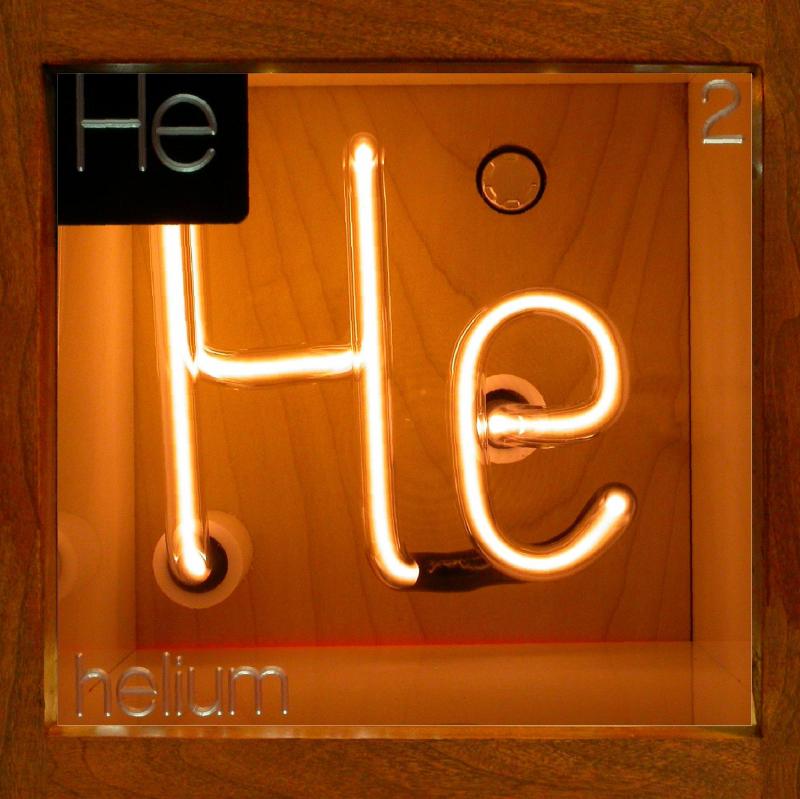
Hooray for Helium!


The single most extraordinary thing about helium is this: it was discovered on the sun before it was ever discovered on the earth, way back in 1868, when the lines on the emission spectrometer turned on it gave back a result that, at first, solar-observing scientists thought was sodium until they realized what it was they had. In fact, that's where the name for the element comes from: helium, like Helios, Greek god of the Sun.

(Incidentally, whatever happened to Helios, anyway? Come Roman times, Apollo was god of the Sun. The best answer ever came in the Percy Jackson and the Olympians young adult books: poor Helios was "downsized" by the efficient Romans and his job palmed off to an already overworked god.)

As point in fact, there is almost no helium on earth; it is light enough that it evaporated during the planet's formation, and any new helium tends to float off into space. The occasions where helium exists on earth, it's produced by the breakdown of radioactive elements like uranium and thorium and trapped in the earth.

This late discovery - Helium was only discovered on earth in 1895 - is all the more incredible because Helium is the second most common element in the universe. In fact, there is more helium than there is every heavier element put together.


More Helium facts:

Helium is one of the few elements to have no "solid" state, remaining a liquid even up to absolute zero.

Helium (and an isotope of Helium) are one of the few elements to be created by the Big Bang, along with hydrogen, lithium and beryllium. Most of the helium in the universe was created by the big bang, though many more from stellar processes.

The primary use of helium is, believe it or not, in cryogenics and supercold, especially the temperatures needed for powerful magnets. Helium is the second-most chemically inert, nonreactive element and in the column with the Noble Gases, so it makes a great purge gas as it doesn't bond with anything. In fact, there are no known compounds that exist that contain helium. The stability of helium is why it is often created by nuclear processes.

80% of the world's helium comes from refining natural gas in the United States. It was us Americans denying helium as a lifting gas to the Nazis that made them use the more dangerous and flammable gas hydrogen...and led to the Hindenburg disaster.

Why does inhaling helium make your voice higher? Well, here's an involved answer: sound is made by vibrating AIR, not by a vibrating object. Sound, like everything else is a wave, and the faster the number of peaks go by in the wave, the higher the frequency (the more frequent - get it?) and the higher the timbre of a noise. Frequency = Speed/Wavelength, or F = S/W. So, the faster something moves, the greater the number of waves and the "higher" a sound is. Since helium is less dense than air, sound goes through more quickly, and therefore the frequency is higher. Don't worry, helium is inert: the only danger comes from possible oxygen deprivation. There are some gases heavier than air that make vibrations travel more slowly, of course, like sulfur hexaflouride and krypton, but unlike helium these may be dangerous to try. They stay in your lungs as they "sink" in air.

Monday, July 26, 2010

Upcoming movie about the real Hypatia


Hypatia is my hero and it's not hard to see why. In the world of Hellenistic Greece, she stood out as a great thinker and teacher, a pagan in a time of mostly Christians, one of history's greatest mathematicians.

Rachel Weisz is going to be playing Hypatia, the single most obvious and appropriate casting choice in the history of Hollywood. I wait with eager anticipation to see "Agora," a movie about the life and challenges of Hypatia and the Library of Alexandria. It's not very often that Hollywood does a movie about a mathematician...the last one I can think of is A Beautiful Mind. It doesn't hurt that Hypatia was supposedly one of the world's most beautiful women, or is at least romanticized as being that way by poets. Carl Freidrich Gauss and Paul Erdos may be great mathematicians, but they definitely don't have much in the way of sex appeal.

I have no idea how it is that I didn't hear about this movie until today. It totally blindsided me, and I usually keep my pulse on movies about math and my hero, Hypatia.

Feast your eyes on the trailer, spuds:


By the way, after several years of text flying at the screen and quick cuts passed as movie trailers, isn't it great to hear an old-fashioned Voice of Doom trailer again? "In a world of conflict and torment...one woman will rise to lead a nation..." It's like the movie trailer was made in 1994!

Sunday, July 25, 2010

"New Horizons" Space Probe to Explore Pluto and the Kuiper Belt


Astronomers have more of a sense of humor than any other kind of scientist I know. Take for instance, the "New Horizons" space probe, which in five years will reach Pluto, the first manmade object to study the only truly unexplored region of the solar system, not to mention the Kuiper Belt, the distant and massive asteroid belt beyond Neptune where Pluto and at least several other dwarf planets of its type reside...including several that are much larger. By July, 2015, the probe will reach Pluto.


Not only was the space probe named after a Moody Blues song, the telescope and multispectral imager is named "Ralph," and the ultraviolet image spectrometer is named "Alice." What's even more amazing is that the Dust Counter used by the New Horizons was designed and built by graduate students...who I am colossally envious of to the point of murderous rage.


Words can't express my excitement at this visit to the only unexplored world in the solar system. THE HUMAN ADVENTURE IS ONLY BEGINNING. The only down side is they can't make a flyby past Eris, the recently discovered Trans-Neptunian Object...which is, in many ways, like Pluto's cooler sister. Amazingly, the probe will even leave our Solar System in 2029!

Friday, July 23, 2010

James Randi exposes a psychic

This clip is a bit long, but it is totally worth it to watch in its entirety.

James "The Amazing" Randi, a personal hero of mine, debunks a phony psychic with telekinetic powers. Like Houdini, James Randi is a stage magician and skeptic/rationalist that devotes his efforts to exposing phony psychics by using his expertise as a performer and sleight of hand artist to figure out how so-called "mentalist," "medium" and "telekinetic" feats are done. James Randi also uses experiments to put claims to the test. One of my favorite recent ones is, he debunked the claim that more expensive connection cords improve picture quality.


What's the harm in psychics, after all? After all, they're not encouraging people to not get their children vaccinated, which is negligent and dangerous to the point of evil. They're not making outrageous claims about infinite petroleum under the earth and discouraging development of alternative energy. They're not stunting the understanding of children with fraudulent and untrue non-science like creationism.

The harm that psychics pose is that they blur the line between the real world and the untrue. Whether something makes good showmanship has nothing to do with whether it is true or not, and thus far, no one has been able to demonstrate under controlled conditions any ability to talk to the dead or move objects with their minds. When we go to see a romantic comedy, we enjoy it because we can understand that real-world romance isn't like that.

By the way, the claim that the heated lights together with the polystyrene created static electricity that prevented his mind power from operating? That's such transparent bullshit that it almost isn't worth debunking...but to flex my chemist muscles, here's why that couldn't be true:

Static electricity increases the colder it gets, not the hotter.

Why? Because the colder air is, the less humidity it stores. The more dry the air, the more likely there can be static. The factor that determines the amount of moisture that can be held at a temperature is called "Relative humidity." The RH, the capacity for air to be saturated with water, drops by 50% for every 10 degrees Celsius the temperature rises or drops.

(Incidentally, this tends to be how dehumidifiers work: by cooling air off. Sure, it works, which is more than I can say for some products, but it's hardly a mysterious process and is pretty much a glorified mini air conditioner. Egad, what mysterious process has taken place here? Sometimes, human stupidity is a bottomless pit.)

Monday, July 12, 2010

How do Ouija boards work, really?


In a ton of movies, Ouija boards are used to contact evil powers from beyond, who give eerie advice and open the gateway for malevolent spirits to reach our cosmos. Generally, this is extremely unusual performance in a game made by Parker Brothers.

Personally, I think it's all misdirection, and the truly Satanic game is Monopoly. Think about it: have you ever played it with your family and not had it result in arguments, tension, and bad feelings? It's like that game was created by demons to spread anger and discord.

What exactly is, then, the scientific explanation for how Ouija and other spiritualist talking boards work? After all, they seem to result in intelligible data.

The answer is the phenomena called the "ideomotor effect." The ideomotor effect, in a nutshell, is that our bodies can move involuntarily without our being actively aware of it, that at times muscular impulses are made without any volition on our part, without any conscious desires or emotions. Breathing, for example, is a well-known example of an ideomotor impulse.

With a Ouija board, however, movement exists that is consistent with our subconscious impulses. Ideomotor effects have been shown to be extremely vulnerable to suggestion; in fact, a person with strong ideomotor activity can also easily enter a hypnotic state.


Ideomotor effects seem supernatural, and are the scientific basis behind not only Ouija boards but also "dowsing" and pendulum-swinging divination.

Here's the thing about everything on this blog: you don't have to take my word for it, look it up. But this time I actually encourage you to try this out for yourself. Wear a blindfold, hold a Ouija board, and have a partner read what you produce. It will produce unintelligible gibberish (or alternatively, like the infinite monkeys on infinite typewriters, you'll produce the greatest novel ever written).

Sunday, July 11, 2010

Altitude map of the planet Mars


Now for some good stuff - a topographical map of the planet Mars arranged by altitude. Notice the southern hemisphere is so much higher!

There are some points that go way, way higher than 8km on Mars, but that's because this picture is what the scientist Gauss calls a Geoid - a crucial concept in planetary mapping and geodesy, a sort of surface model/figure of the earth (or other planets) that smooths out extremes by surface gravity. However, the use of 8km as a base shows it goes by earth gravity - which may result in a less useful model.

A geoid is very different from say, a reference ellipsoid, which is a smoothed out, idealized diagram of the earth. These two are used together in the field of Geodesy, which is scientific surveying, how maps are constructed and GPS works. It is the use of mathematics to determine altitudes and points on a map.

If you're like me, you're the sort that gets curious and asks questions, and one for me is this: how exactly is that they KNOW that Mt. Everest is the highest mountain on Earth? The answer is that it wasn't known. Until 1849, it was commonly believed that Kangchenjunga in North India was the highest mountain in the world (today, it is believed to be the 3rd tallest).